How to Get the Classic Machu Picchu Photo
Want the iconic Machu Picchu photo? The viewpoint is ticket-specific, fog can hide everything, and crowds queue—here’s how to get the shot right.
A viewpoint depends on your ticketed route. A guide cannot guarantee clear skies, reverse the one-way circuit, or add a second entry.
| Location | Guardian’s House area, upper agricultural terraces, southeast corner of site |
| Elevation | ~2,430 m (same as general site; ~15–20 min uphill walk from main gate) |
| Tickets that reach the classic viewpoint | Routes 1A, 1B, 1C, 1D (Circuit 1); Routes 2A, 2B (Circuit 2 lower platform) |
| Ticket that does NOT reach it | Routes 3A, 3B, 3C, 3D (Circuit 3, includes Huayna Picchu hike) |
| Best time for clearest view | 9 AM–noon (dry season), 2–4 PM (any season, fog usually cleared) |
| Best time for atmospheric/moody photo | 6–7 AM (mist, golden light, fewer people but fog risk is real) |
| Tripods / selfie sticks | Prohibited; violation leads to expulsion, no refund |
| Time rangers suggest at viewpoint | ~15 minutes; ranger may ask you to move on during peak hours |
| Best months for clear skies | May–September (dry season) |
| Worst months for fog | January, February, March |
| Sunrise ticket cap (Circuit 1 at 6 AM) | ~30 tickets only; sells out weeks to months ahead |
| No re-entry | All tickets are single-entry; you cannot return to the viewpoint after exiting |
What Exactly Is the Classic Photo and Where Is It Taken?
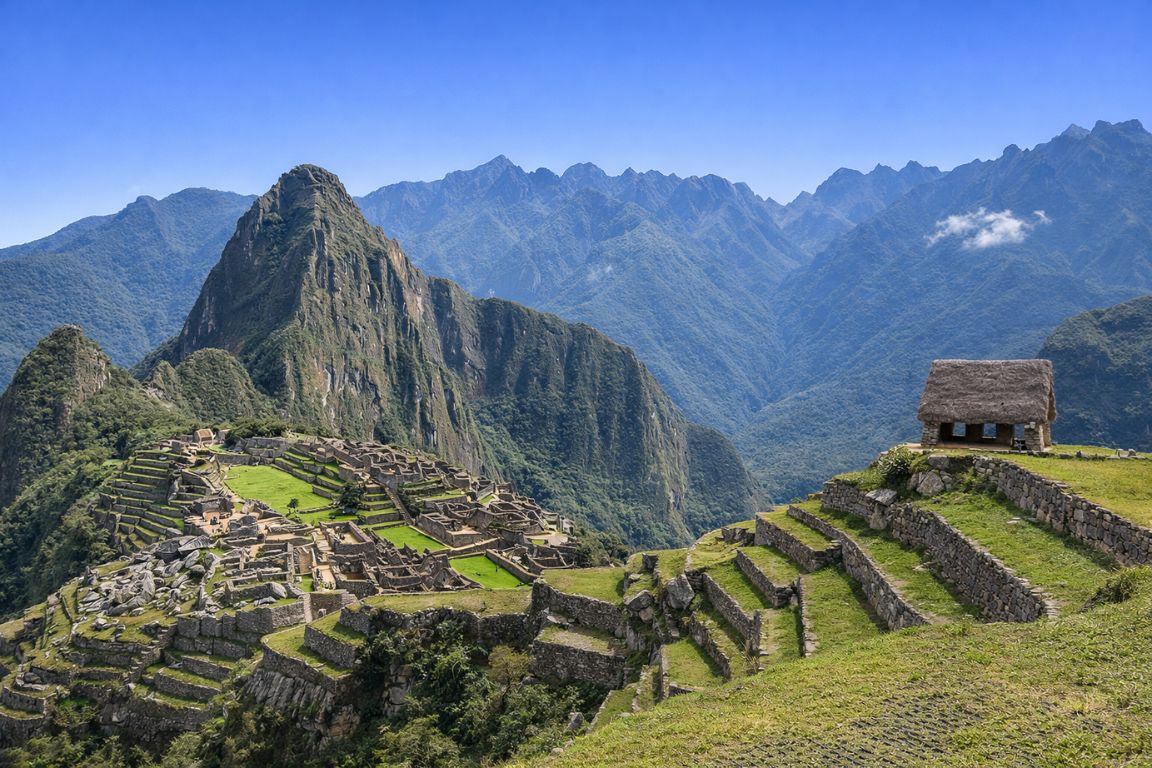
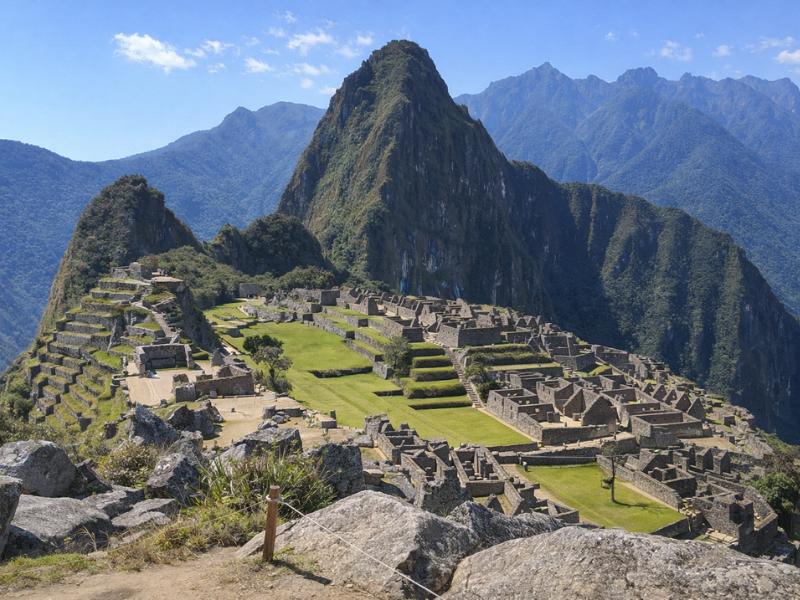
The image has one specific frame. You are standing on an elevated terrace above the main citadel, looking roughly northwest. In front of you: the agricultural terraces descending in their famous stepped rows, then the urban sector with the Main Plaza, the Temple of the Sun, and the larger temple complexes beyond. Behind everything, Huayna Picchu mountain punches up against the sky. That mountain silhouette is what makes the composition. Without it, you have ruins. With it, you have the photo.
The spot itself is near the Guardian’s House a rustic, thatched-roof structure that is the only building at Machu Picchu still carrying its original ichu grass roof. You cannot enter it, but you stand beside and above it on the terraced platform. The Guardian’s House was built as a watchtower and rest point for Inca messengers (chasquis) traveling the trail from the Sun Gate. Its position, high on the southern ridge of the site, gives the commanding angle that makes the classic view possible.
One thing that confuses people: there are actually two main platforms in this area, not one. The Platforma Superior (Upper Platform) sits above the Guardian’s House and is accessed via Circuit 1 tickets. The Platforma Inferior (Lower Platform) is on the terrace just below the Guardian’s House and is reached on Circuit 2 tickets. Both platforms give you a version of the classic view. The upper platform is higher, wider, and delivers the more expansive panorama that appears in most magazine photographs. The lower platform puts you slightly closer to the ruins with a tighter, more intimate angle that includes the agricultural terraces as a strong foreground. Neither is wrong they are different compositions from the same location, and which one you get depends entirely on which ticket you bought.
Which Ticket Gets You to the Viewpoint?
This is where the most expensive mistakes happen, so pay close attention.
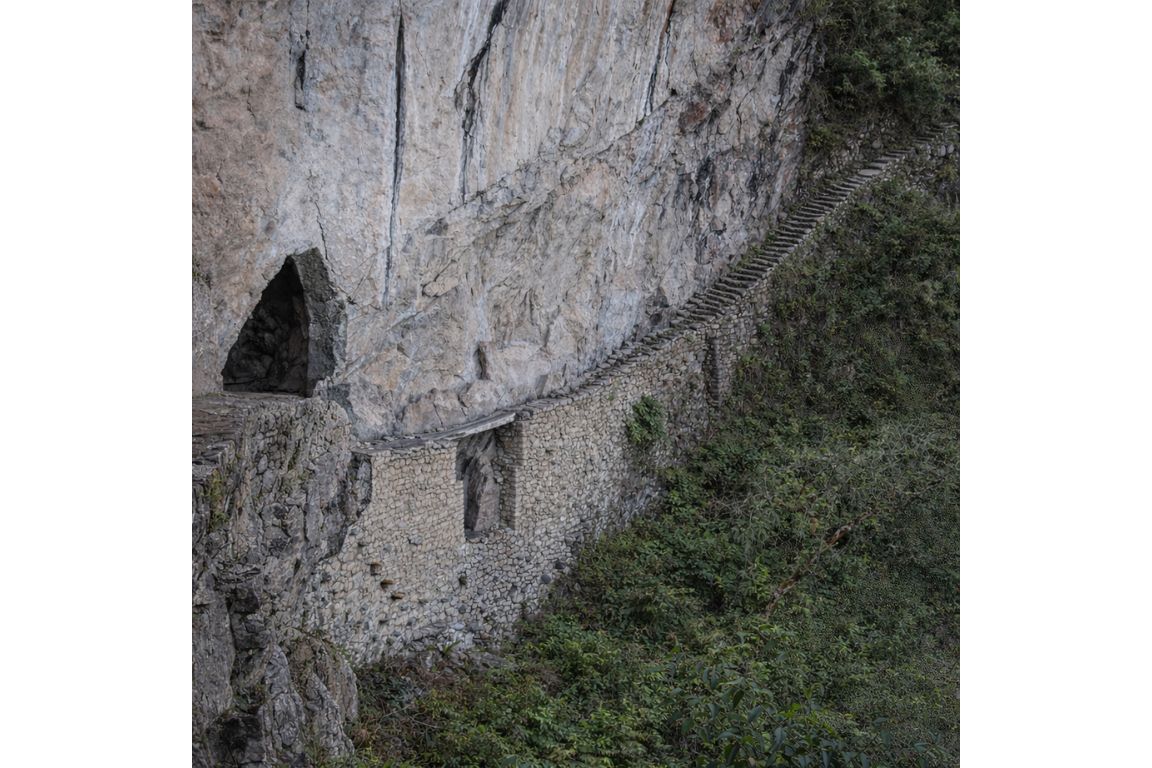
Circuit 1 (all four routes: 1A, 1B, 1C, 1D) takes you to the Platforma Superior the highest viewpoint. These routes are designed specifically for panoramic views. None of them include access to the lower urban sector of Machu Picchu; you walk the upper terraces and that is your visit. Route 1B (“Classic Photo / Upper Terrace”) is the stripped-down version: you hike up, spend time at the platform, then exit. The whole visit takes 90 minutes to 2 hours. Routes 1A (Machu Picchu Mountain), 1C (Sun Gate), and 1D (Inca Bridge) add hikes on top of the viewpoint stop.
Circuit 2 (routes 2A and 2B) takes you to the Platforma Inferior on the way down into the main citadel tour. You get the classic view from the lower platform, then continue through the urban ruins the Temple of the Sun, the Main Temple, the Temple of the Three Windows, the Sacred Rock. These two routes offer both the postcard angle and a full tour of the site. For most first-time visitors this is the better choice if you want both the photo and the ruins.
Circuit 3 (routes 3A, 3B, 3C, 3D) begins from the lower entrance and takes you directly into the citadel without reaching the Guardian’s House area at all. Route 3A includes the Huayna Picchu mountain hike. This is the change that catches people: prior to 2024, the Huayna Picchu ticket gave access to the upper terraces. Under the current system it does not. You enter from below, hike Huayna Picchu, and exit having never stood at the classic viewpoint. Some websites still describe the old system. The new system has been in place since June 2024 and is how tickets work now.
If you’re staring at the booking page wondering what the circuits mean, here’s Machu Picchu ticket types explained so you don’t accidentally book the wrong one.
Booking tip: If getting the classic photo is your primary goal, choose Route 1B for the viewpoint only, or Route 2A/2B for the viewpoint plus a full citadel tour. If you also want to hike Huayna Picchu, you will need to buy two separate tickets on two separate days one Circuit 1 or 2 ticket for the viewpoint, one Circuit 3A ticket for the mountain. Book a Circuit 1 guided tour for the viewpoint day, then a separate Circuit 3A ticket if you also want the Huayna Picchu hike.
What Time of Day Is Best for the Shot?
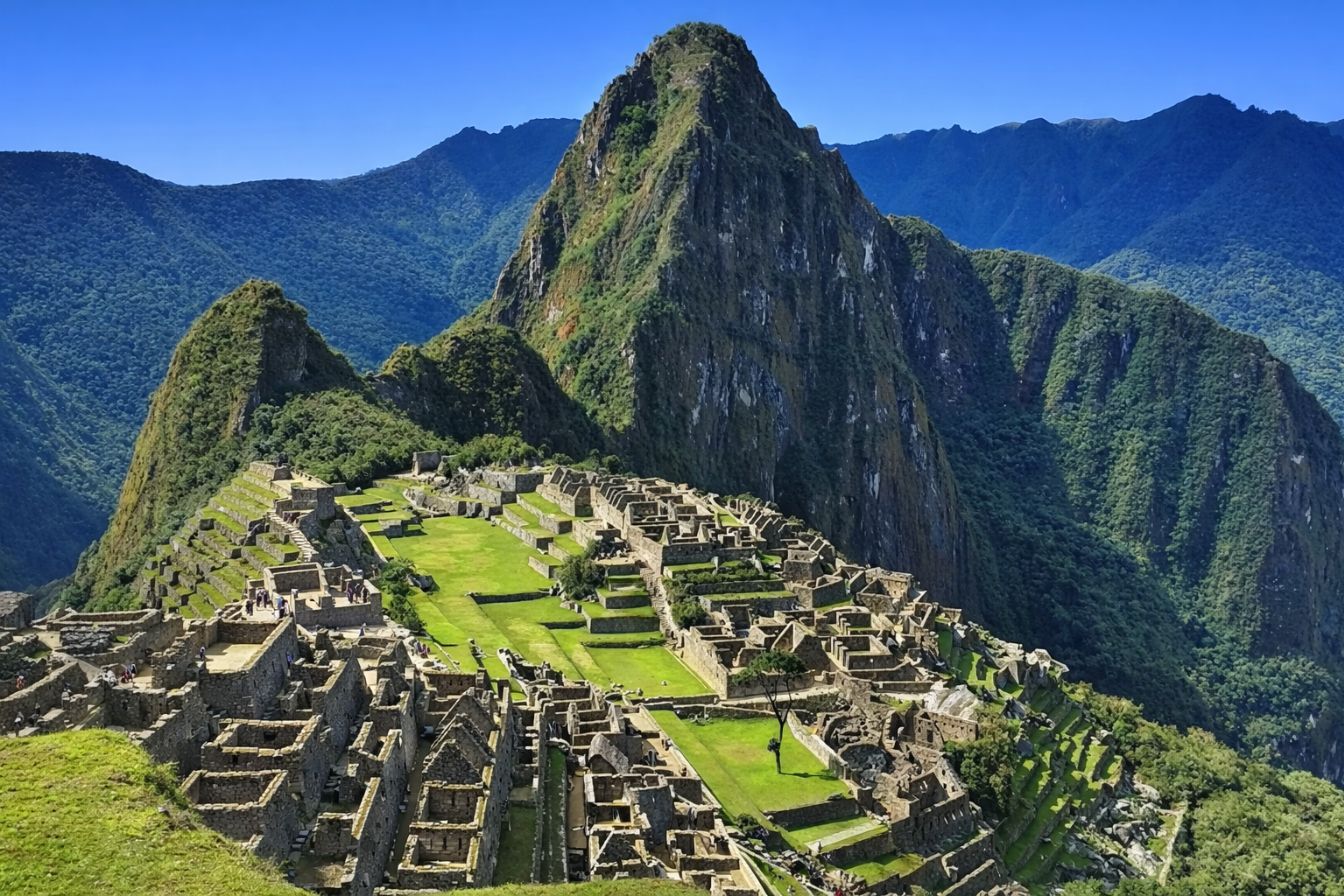 The honest answer is that the “best” time depends on what kind of photo you want. Most articles say go early and leave it there. That advice is incomplete, and for some travelers it leads to disappointment.Early morning (6–8 AM) gives you soft golden light, the lowest crowd density of the day, and a good chance of atmospheric mist rising from the valley below. When everything goes right, the mist hangs just below the ruins while Huayna Picchu catches the first light and you get a photograph that looks like it belongs on a travel magazine cover. This is the shot most photographers are chasing.The problem: early morning is also when fog is heaviest. Machu Picchu sits inside a cloud forest. Warm humid air from the Amazon basin rises overnight and settles over the citadel in the early hours. On a bad morning, especially November through March, you will reach the platform at 7 AM and see nothing but white. The ruins are there, three hundred meters below you, and you cannot see any of them. People wait. The fog may lift at 9:30 or it may sit until noon. There is no guarantee.Late morning to midday (9 AM–noon) is when the fog most reliably clears, even during wet season. The sun warms the air, the mist rises and breaks, and you get clear views of the entire site. Light is harder at this time higher in the sky, more contrast on the stonework but the ruins are visible and the composition is achievable. Crowds are also at their peak between 10 AM and 2 PM.Afternoon (2–4 PM entry) is genuinely underrated and almost nobody recommends it. By 3 PM, the morning fog is gone, crowds have thinned noticeably, and the sun has moved to a position where it starts warming the stone with directional golden light. An afternoon entry also gets you to the platform around 3:30–4 PM, right as the late afternoon glow kicks in. The quality of that light on the Inca stonework, with the terraces in shadow and the peaks still illuminated, produces photographs that are harder to get in the flatter morning light. If your goal is clear visibility with warm light and fewer people in the frame, afternoon entry is worth serious consideration.One practical note: the earliest Circuit 1 / Route 1B tickets at 6 AM are limited to roughly 30 per day. If you want the upper platform at sunrise, you are competing for those 30 slots against everyone else who read the same travel blogs. They sell out weeks or months ahead during peak season. Circuit 2 has more capacity at the 6 AM slot, but puts you on the lower platform.
How Do Crowds, Clouds, and Season Affect Your Chances?
Weather at Machu Picchu follows two seasons with shoulder periods on either side. The pattern is consistent enough to plan around, even if individual days remain unpredictable.
| January | Wet | 22 | Very High | 30–40% | Low | High risk; moody shots possible, clear view uncertain |
| February | Wet (peak) | 20+ | Very High | 20–30% | Very Low | Hardest month; Inca Trail closed; lush green, very foggy |
| March | Wet (late) | 18 | High | 40–50% | Low | Improving; fog often clears by 9–10 AM |
| April | Shoulder | 12 | Moderate | 60–70% | Moderate | Good balance of green landscape and clearer skies |
| May | Dry (start) | 8 | Low–Moderate | 75–85% | Moderate–High | Excellent; crowds building but skies reliable |
| June | Dry | 5 | Low | 85–90% | Peak | Best weather, highest crowds; book 3–4 months ahead |
| July | Dry | 4 | Low | 85–90% | Peak | Best weather, highest crowds; windiest month |
| August | Dry | 6 | Low | 80–85% | High | Excellent; slight increase in afternoon cloud |
| September | Dry (late) | 8 | Low–Moderate | 70–80% | Moderate–High | Good; more unpredictable than June–August |
| October | Shoulder | 14 | Moderate | 60–65% | Moderate | Transition; some days excellent, some fully fogged |
| November | Wet (start) | 16 | High | 45–55% | Low–Moderate | Rain increasing; lush, fewer tourists |
| December | Wet | 18 | High | 35–45% | Low (until Dec 25+) | Heavy rain; holiday week sees spike in visitors |
*Morning clear view probability is based on conditions at 7–9 AM. Afternoon (2–4 PM) probabilities are 15–25% higher across all months. Data reflects patterns tracked through our guided tour operations at machupicchuguided.tours; individual days vary.
The dry season runs from May through September, with June and July being the most reliable months for clear sky photographs. The tradeoff is crowds. Daily capacity during peak season reaches 5,600 visitors, and the viewpoint platform becomes genuinely congested by 9 AM. The queue for a clear shot at the railing can be 20 to 30 minutes.
Shoulder months April, May, September, October offer a middle path. Skies are reasonably clear, crowds are thinner, and the landscape is greener than the peak dry season. Many experienced travelers consider April and September the best months for photography overall, because you get favorable light and cleaner compositions without fighting through peak crowds.
The wet season (November through March) brings persistent fog and rain, particularly in the mornings. What most articles do not say clearly: even during the wet season, mornings that start foggy often clear by 9 or 10 AM. If you have a wet-season visit, build in waiting time. Go to the platform early, absorb the atmosphere, and wait. The fog usually moves. When it does, and when the citadel suddenly materializes out of white haze below you, the photograph you get is unlike anything possible on a clear summer morning.
Timing can make or break your experience up there. The best time to visit Machu Picchu guided tours depends on weather, fog levels, and how many other tourists you’re willing to share the ruins with.
What Camera Settings and Gear Actually Matter?
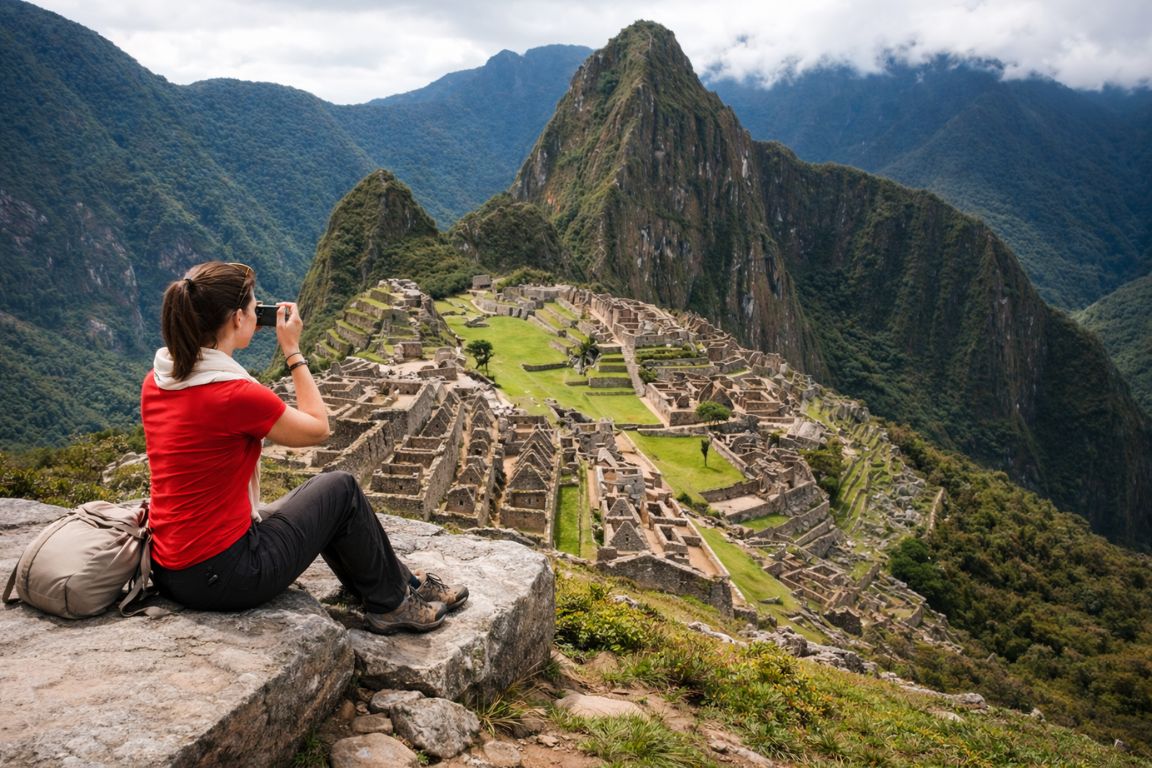
The most important piece of equipment at Machu Picchu is not your camera. It is your feet and your timing. The site’s regulations remove most technical options that would otherwise give you an edge no tripods, no selfie sticks, no monopods, no gimbals, no drones. None of those are negotiable. Violators are expelled from the site with no refund. Rangers enforce this.
What that means in practice: you are shooting handheld in a location where you cannot always stand still, where other visitors are constantly moving in and out of your frame, and where you have a suggested 15-minute window at the platform before rangers start nudging people to keep moving during peak hours. Modern cameras and phones handle this well given the outdoor light. The constraints are less limiting than they sound.
For lens choices, a wide angle (16–35mm equivalent) is what produces the classic composition citadel in the foreground, Huayna Picchu (book tour here) rising in the middle distance, sky above. A standard zoom (24–70mm) is more flexible and works for both wide compositions and detail shots as you move through the site. Telephoto lenses above 200mm equivalent are rarely useful at the classic viewpoint; the distance is too short for compression to work in your favor, and longer lenses narrow the field in a way that loses the grandeur of the frame.
A polarizing filter is worth bringing. At this altitude, the UV index runs high and haze on clear days can flatten the scene. A polarizer cuts that haze, deepens the blue of the sky, and increases apparent contrast on the stone surfaces. It works in a socket filter or as a screw-on, and it does not require a tripod.
For camera settings in the morning with some mist, start around f/8 for depth of field across the full scene, ISO 200–400, and let the camera read the shutter speed. The citadel is not moving. The main technical risk in early light is underexposing the shadows on the terraces while the sky is much brighter. Some exposure compensation (+0.7 to +1 stop) or shooting RAW and recovering in post handles this. In clear midday light, tighten to ISO 100 and f/8–f/11 and you will get sharp captures at any shutter speed.
Phone cameras produce excellent results at this location in good light. The computational processing in current generation phones handles the high-contrast mountain scenes well. The main limitation is wet or foggy conditions, where the scene is low-contrast and the phone’s processing sometimes makes things look artificially flat. A dedicated camera with manual exposure control gives you more to work with in those conditions.
Wondering about the right gear? Check out our breakdown of what to wear to Machu Picchu guided tours – the weather can shift dramatically even during one visit.
| Platforma Superior (Upper) | Route 1B, 1A, 1C, 1D | Above Guardian’s House | Widest panorama; most sky and mountain in frame | 6–8 AM (limited) or 2–3 PM | Upper terraces only; no citadel tour | Does not include lower citadel; ~30 tickets at 6 AM slot |
| Platforma Inferior (Lower) | Route 2A, 2B | Below Guardian’s House | Tighter frame; stronger terrace foreground; more intimate | 6–8 AM or 2–3 PM | Full citadel tour: Temple of Sun, Main Temple, Sacred Rock | Higher crowds at peak hours; viewpoint stop is brief before continuing into citadel |
| Afternoon Entry (2–3 PM) | Route 1B or 2A/2B | Either platform above | Warm directional light 3:30–5 PM; fewer people in frame | Enter 2–3 PM | Depends on route chosen | No sunrise; site closes at 5:30 PM; last buses down at 5:45 PM |
| Circuit 3 / Route 3A (Huayna Picchu) | Route 3A | None no viewpoint access | No classic postcard angle from this ticket | 7–9 AM (Group 1 or 2) | Lower citadel tour + Huayna Picchu hike | Miss the classic view entirely; requires second ticket on another day |
What Are the Rules You Cannot Break at the Viewpoint?
The photography rules at Machu Picchu are stricter than most visitor sites and are actively enforced. These are not suggestions.
No tripods, monopods, selfie sticks, or any stabilizing extension for cameras or phones. This prohibition is absolute, applies to compact tabletop tripods as well as full-size ones, and covers gimbals. The stated reason is pathway congestion the walkways around the platform are narrow and the combination of many people carrying extended equipment caused accidents. Enforcement: rangers will confiscate equipment or expel you.
No drones. The entire Machu Picchu sanctuary airspace is a no-fly zone. Fines are substantial and equipment is confiscated. This extends to launching from outside the park boundaries and flying in the prohibition covers the airspace, not just the ground.
No climbing, sitting, or leaning on Inca walls or structures. This includes the terrace retaining walls and the stone edges of the platform. The surfaces are 500-year-old construction and irreplaceable.
No re-entry on the same ticket. Once you exit through any gate, your ticket is voided. This matters for photography planning: you cannot leave the platform area, visit the citadel, and come back to the platform for better light. Your circuit is one-way and one-time.
Rangers will ask you to move on at the platform after roughly 15 minutes during peak periods. This is not a fixed rule but a crowd management measure. If you want more time, arrive during off-peak hours (early morning before the wave arrives, or afternoon) when the platform has fewer people and rangers are not actively cycling visitors through.
Professional photography commercial shoots, extended lighting setups, film production requires prior authorization from the Ministry of Culture and involves separate permits and fees. If you are shooting for personal travel or editorial use as a visitor, your regular ticket is sufficient.
Not sure about the rules? Check out our guide on do you need a guide for Machu Picchu guided tours – the answer changed a few years ago and catches a lot of people off guard.
What If the View Is Fogged In? Your Backup Plan.
This happens. It happens in the dry season too, though less often. Here is how to handle it without wasting your visit.
First option: wait. The fog at Machu Picchu is produced by moist air rising from the valley overnight and settling in the early morning hours. As the sun heats the air, typically between 9 and 11 AM even in wet season, the fog rises and breaks. It does not always clear completely, but partial clearing happens often. A scene that is total white at 7 AM may be fully visible by 10. If you are on a Circuit 1 ticket with a 2-hour time limit starting at 6 AM, waiting means using most of your time at the platform. If you are on Circuit 2 with full citadel access, you have more flexibility go explore the lower ruins first, then come back up toward the end of your allotted time when the fog has usually had a chance to lift.
Second option: embrace it. Machu Picchu in the fog produces photographs that are genuinely different in character from clear-sky shots, and not in a way that makes them lesser photographs. The mist creates depth and atmosphere. The moment the ruins reveal themselves through moving cloud cover is one of the most photographed phenomena at the site. Some of the most widely published Machu Picchu images are misty ones. If the fog is not going to clear, lean into it: shoot when sections of the citadel emerge briefly, work the foreground terraces with the misty backdrop, use the soft diffused light to capture stonework texture.
Third option: adjust your position. The lower terrace platforms (Circuit 2) are sometimes above the cloud bank when the upper area is fogged in, and sometimes below it when the upper platforms are clear. This is not predictable, but if you have flexibility to move between circuits through a multi-ticket visit, different elevations can give different conditions on the same morning.
Fourth option: afternoon. As noted throughout this guide, afternoon entry eliminates morning fog almost entirely. If your morning visit was completely fogged out, and you have a second ticket or can book one, a 2 PM entry on the same or following day typically finds clear conditions at the viewpoint. The site is open until 5:30 PM. The buses run until about 5:45 PM from the Aguas Calientes bus terminal. An afternoon visit is a full visit, not a partial one.
The one scenario where you should not hope too hard: a full low-pressure system parked over the Cusco region for several days during wet season. When that happens, visibility at the viewpoint may be near zero for extended periods and no amount of waiting will produce a clear view. If weather forecasts before your visit show persistent regional overcast, build in psychological flexibility. The site itself the stonework, the history, the scale, the living ecology of the cloud forest remains extraordinary even when you cannot see Huayna Picchu. The classic photo is not the only thing Machu Picchu has to offer.
Worried about weather timing? A full-day private tour by train includes a dedicated guide who can change the on-site order if the platform is still in cloud. A Circuit 1 tour is the upper platform; a Circuit 2 tour adds the citadel after the lower platform.
Is It Worth the Planning?
Yes, but knowing what you are planning for matters. The classic Machu Picchu photograph is a specific composition from a specific platform, accessible on specific tickets, best in specific light and weather. None of that is complicated once you understand the system but the system is not intuitive, and the 2024 circuit changes added a layer of confusion that most general travel guides have not caught up with.
The short version: book a Circuit 1 (Route 1B) or Circuit 2 (Route 2A/2B) ticket. Do not assume your Huayna Picchu ticket includes the classic viewpoint it does not under current rules. If you want the best light with the fewest people, consider a 2–3 PM entry rather than defaulting to the morning rush. If fog is a concern, early morning is riskier than late morning or afternoon. And if the clouds roll in, wait them out or work with them instead of against them.
The photograph is worth it. Standing at the platform with Machu Picchu below you and Huayna Picchu behind it, in whatever light the mountain decides to offer that day, is one of those moments that lives in your memory regardless of how the image turns out.
Ready to plan your visit? Start with a Circuit 2 guided tour with entrance ticket if you want the classic view and the ruins on the same visit.
Written by Diego Alejandro Ramirez
Peruvian tour guide since 2009 · Founder, Machu Picchu Guided Tours
Diego has guided over 1,600 travelers through Machu Picchu and the Sacred Valley since founding the agency.
Book Access To The View You Want
Check your date before arranging the rest. We may earn commission through this booking link.